Embroidery Floss Guide: Thread Types for Beginners
Six-strand cotton floss and perle cotton are the two threads most beginner patterns use. Learn how they differ, what the color numbers mean and how to pull floss from a skein without a tangle.
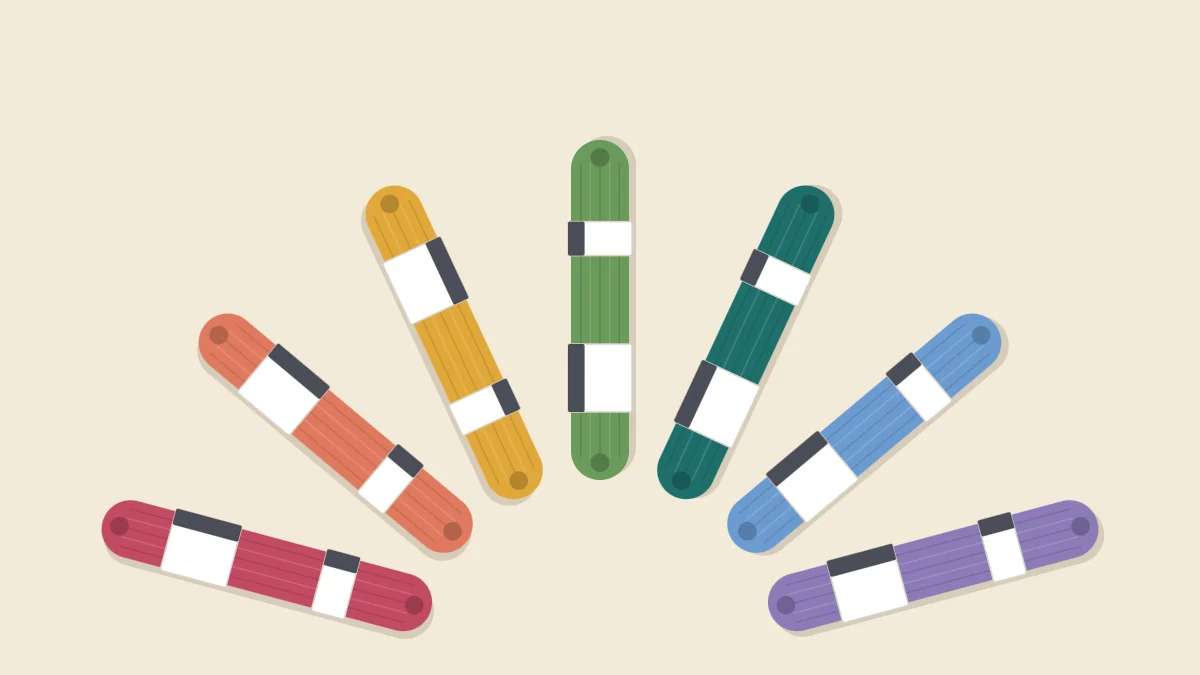
Pick up a skein of embroidery floss and roll the cut end between your fingers: it opens into six thin strands. That one detail explains why floss is the standard thread for hand embroidery. You decide how many of those strands go through the needle, so a single skein can stitch a hair-fine line or a bold, raised one.
The Two Threads Beginners Meet First
A craft-store thread wall holds many kinds of thread, but two cover nearly every beginner pattern. They are lettered A and B below.
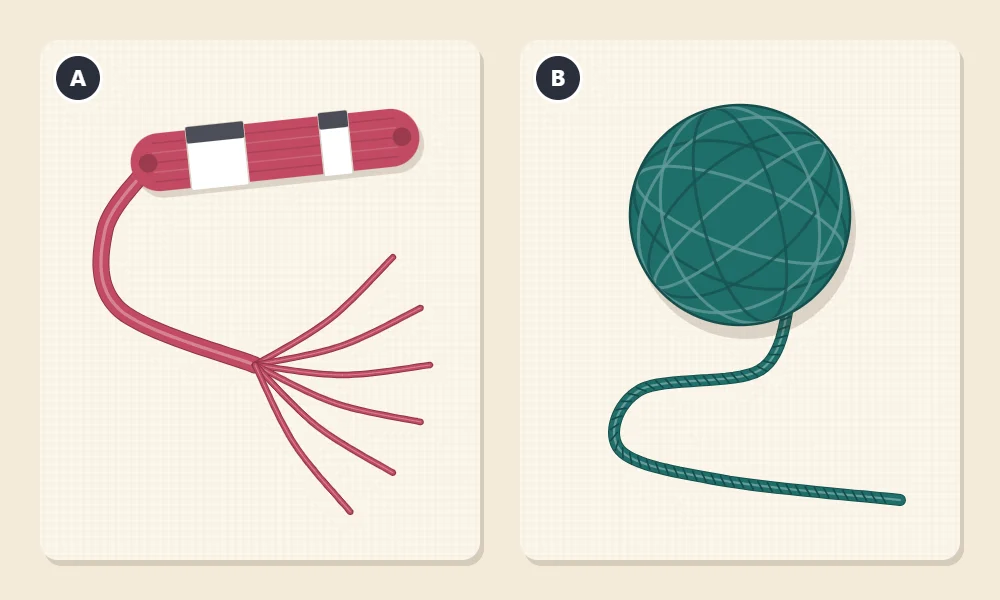
A: Six-Strand Cotton Floss
Also called stranded cotton, this is the thread most patterns mean when they simply say “floss”. Six fine strands lie loosely side by side, and each strand is itself made of two plies twisted together. It has a soft sheen and comes in a very wide range of colors. A skein usually holds about 8.7 yards (8 m).
The strands are meant to be taken apart. Patterns state how many to use, most often two or three for outlines and general stitching, one for fine detail and all six for a chunky look. Even when a pattern asks for all six, the usual practice is to separate the strands and lay them back together, because they lie flatter and cover better that way. The method is in how to separate embroidery floss.
B: Perle Cotton
Perle cotton, also spelled pearl cotton, is a single, firmly twisted thread with a noticeable shine. It is not divisible: you use it exactly as it comes off the ball or skein. The twist gives stitches a rounded, slightly beaded texture that stands up from the fabric, which looks especially good in knots and in line stitches.
Because you cannot change the strand count, you change the thread size instead. Perle cotton is commonly sold in sizes 3, 5, 8 and 12, and, like needles, the numbering runs backward: size 3 is the thickest and size 12 the finest. Sizes 5 and 8 are the ones used most for general embroidery.
| A: Six-Strand Floss | B: Perle Cotton | |
|---|---|---|
| Structure | Six loose strands | One tightly twisted thread |
| Divisible | Yes | No |
| How you change thickness | Use more or fewer strands | Choose a different size |
| Look | Smooth and flat with a soft sheen | Rounded and textured with more shine |
| Usually sold as | Skein | Ball or twisted skein |
For learning, start with six-strand floss. It is what most beginner patterns are written for, and controlling the strand count teaches you a lot about how line weight works.
Reading the Bands and Color Numbers
A skein is held together by two paper bands. The long band carries the color number, and that number matters more than the color’s name. Patterns list floss by number, and it is the only reliable way to get the same shade again when a skein runs out.
Two things to know about color numbers:
- Each manufacturer has its own numbering system. A number from one maker does not mean the same color from another. If a pattern lists numbers for a range you do not have, a conversion chart can suggest the nearest match, but matches are approximate.
- Keep the number with the thread. When a skein gets too loose to hold its bands, wind it onto a bobbin and write the number on it straight away.
How patterns use these numbers alongside a color key is covered in how to read an embroidery pattern.
How to Pull Floss From a Skein Without Tangles
A skein is wound so that thread can be drawn out of it while both bands stay on. Taking the bands off first is what produces the well-known knotted mess.
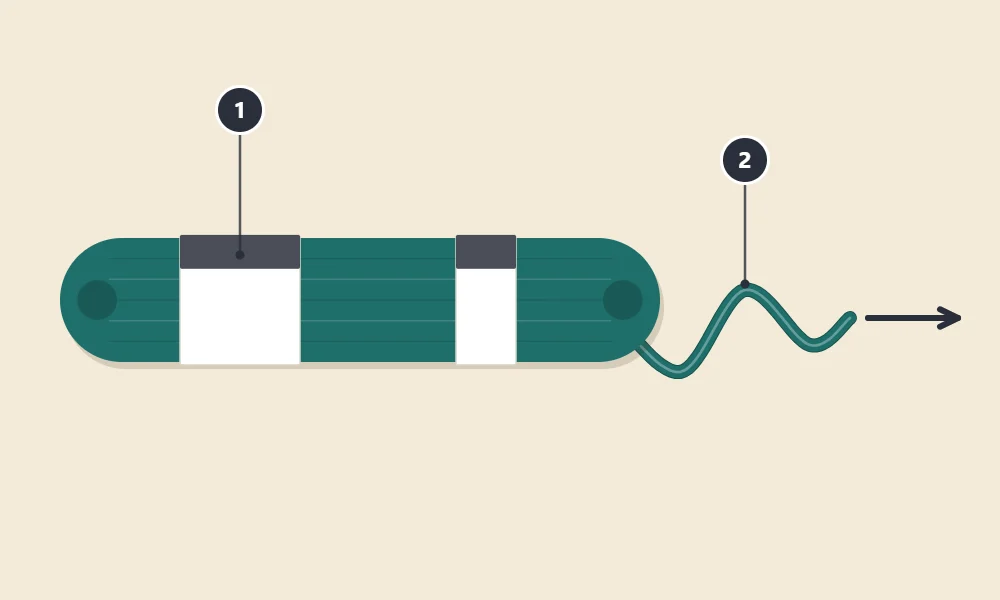
- Leave both paper bands on the skein. Find the long band (1), the one printed with the color number.
- Look for the loose tail (2). One end of the floss is tucked inside the skein and the other sticks out; you want the one that slides out freely.
- Hold the skein loosely around the long band with one hand. Do not squeeze it.
- With the other hand, pull the tail slowly and steadily in the direction of the arrow. The floss should feed out smoothly.
- If the skein bunches up or the tail resists, stop. Do not tug. Ease the bunch back and try the tail at the other end instead.
- Pull out a length about as long as your forearm, roughly 18 inches (45 cm), and cut it with sharp scissors.
Tip
Resist cutting a long length to save re-threading. Floss wears and loses its sheen as it is drawn through fabric again and again, and a long thread twists and knots far more readily. A forearm’s length is easier to manage from the first stitch to the last.
Once the length is cut and divided, a clean-cut end makes the next step, threading the needle, much quicker. The number of strands also decides which needle to use; the embroidery needles guide gives starting sizes.
A Starter Color Palette
You do not need a full color range. Eight to ten skeins chosen with a little thought will carry you through several small projects:
- Two greens, one lighter and one darker, for stems and leaves.
- Two or three flower colors that sit well together, such as a pink, a coral and a soft yellow, or a blue, a lavender and a white.
- One warm yellow or gold for flower centers.
- One dark neutral, such as charcoal or dark brown, for outlines and lettering. It is often softer on the eye than pure black.
- White or cream for highlights and for stitching on colored fabric.
A light and a dark of the same color family is the simplest way to add depth, so if you add more skeins later, add them in pairs.
A Note on Colorfastness
Colorfastness means how well a dye stays in the thread when it gets wet. Many cotton flosses are sold as colorfast, but no label is a guarantee, and strong, dark shades such as reds, deep blues and black are the ones most often associated with dye running onto pale fabric.
Watch out
Before washing any stitched piece, check the care information for both the floss and the fabric, and test for color bleed first. Dampen a short length of each dark color and press it against a white scrap or paper towel for a few minutes. If color transfers, do not soak the piece.
The full washing routine, with the same cautions, is in how to wash and iron hand embroidery.
Frequently asked questions
How many strands of embroidery floss should I use?
Follow the pattern if it says. Otherwise two or three strands is a good starting point for outlines and general stitching, with one strand for fine detail.
Can I use perle cotton instead of six-strand floss?
Often, yes, but the look changes because perle cotton is rounder and more textured. Choose a size that is close in thickness to the strand count the pattern asks for and test it on a scrap.
Is embroidery floss the same as sewing thread?
No. Sewing thread is a fine, strong thread made for seams, while floss is thicker, softer and made to be seen on the surface of the fabric.
How long should I cut embroidery floss?
About the length of your forearm, roughly 18 inches (45 cm), is a good starting point. Longer threads tangle and wear more easily.